Tax Strategy
Cannabis Tax Preparation for Oregon Businesses
Tax preparation for Oregon cannabis businesses built on reconciled accounting, supported inventory and cost of goods sold records, organized tax workpapers and current-law analysis — for dispensaries, cultivators, processors, multi-location retailers and multi-entity groups.
- Monthly bookkeeping
- Reconciliation
- Year-end close
- Inventory / COGS workpapers
- Tax workpapers
- Current-law tax analysis
- Return preparation
Definition
Cannabis Tax Preparation for Oregon Businesses
Cannabis tax preparation combines year-end accounting records, inventory and COGS workpapers, business tax information and current federal and Oregon tax analysis to prepare the applicable returns and supporting schedules for a cannabis business.
Tax preparation begins long before any figure is entered onto a return. The return is the last step in a sequence that starts with recorded transactions and ends with workpapers that explain where every reported number came from. When that sequence is skipped, the preparer is guessing, and the business has nothing to show if a figure is questioned later.
For a licensed Oregon operator, the sequence matters more than it does for a service business with no inventory. Revenue, inventory, cost of goods sold, payroll, fixed assets, debt and tax liabilities all have to reconcile before they can be reported. Preparation work therefore spends most of its time in the accounting records and the workpapers, not in the software that produces the return.
This page covers historical, year-end return preparation. Forward-looking work lives on Cannabis Tax Planning, and specialized Section 280E analysis lives on 280E Tax Planning.
- Accounting records
- Year-end close
- Tax workpapers
- Return preparation
What is cannabis tax preparation?
The year-end process of closing the books, supporting inventory and COGS, building tax workpapers, applying the federal and Oregon rules applicable to the tax period, and preparing the required returns and schedules.
Why is cannabis tax preparation different?
Inventory, cash-heavy operations, multiple data systems, multiple entities and locations, and — where Section 280E applies — a much closer relationship between cost accounting and the reported result.
Complexity
Why Cannabis Tax Preparation Is Different
Not every cannabis business has the same tax treatment. What they share is a higher burden of documentation.
The complexity is rarely in the return itself. It is in the records behind it. A single dispensary with one bank account and clean point-of-sale data is a different engagement from a three-entity group with a farm, a processing facility and two retail locations sharing overhead. Both need the same discipline; the depth differs.
- Inventory that must be counted, costed and supported
- Cost of goods sold derived from records rather than estimated
- Cash-heavy operations requiring reconciled cash controls
- Multiple data systems that do not agree by default
- Multiple entities under common ownership
- Multiple locations inside a single entity
- Payroll coded by department, location or entity
- Fixed assets and facility improvements
- Debt, related-party notes and accrued interest
- Tax liabilities that are collected, not earned
- Federal and Oregon computations that may differ
- Section 280E considerations where they apply
Foundation
Cannabis Tax Preparation Starts With Reliable Books
A return can only be as good as the accounting records it reports. Preparation is not a substitute for reliable accounting.
The single largest driver of cost, delay and risk in a cannabis tax engagement is the condition of the books when the year ends. If the general ledger is reconciled monthly, preparation is a review-and-document exercise. If it is not, the first several weeks of the engagement are cleanup, and the deadline arrives with less time for analysis.
Before workpapers are started, the accounts that most often carry unsupported balances are reviewed: bank accounts, cash, credit cards, accounts receivable where applicable, accounts payable, payroll, inventory, fixed assets, debt, tax liabilities, intercompany balances and equity. Each one should tie to something outside the ledger — a statement, a count, a report, a schedule, a contract.
Recurring reconciliation work is the province of Cannabis Bookkeeping, and the broader accounting function is covered on Cannabis Accounting. Tax preparation consumes their output; it does not replace them.
- Bookkeeping
- Reconciliation
- Month-end / year-end close
- Tax workpapers
- Tax return
- Tax preparation≠Substitute for reliable accounting
- Bookkeeping≠Tax preparation
- A filed return≠Evidence that the books are right
- Software output≠Supported tax workpapers
Year-end
Year-End Cannabis Accounting Close
The close converts twelve months of activity into a set of balances that can be defended line by line.
A year-end close is more than running a report. It is a structured review of every material balance sheet account and of the activity that produced the income statement. The output is a trial balance where each figure has support behind it, which is exactly what a tax workpaper package needs as its starting point.
Depth varies by operation. A retailer with heavy cash volume spends more time on cash and deposit reconciliation; a cultivator spends more time on production costs and ending inventory; a multi-entity group spends more time on intercompany balances and shared costs. The order of operations, though, tends to be stable.
- Unreconciled books
- Year-end cleanup
- Supported balances
- Tax workpapers
- 01Reconcile bank accounts and merchant deposits to statements.
- 02Reconcile cash on hand, tills and safe counts.
- 03Review revenue against point-of-sale and other source data.
- 04Reconcile accounts payable and review stale balances.
- 05Reconcile payroll registers and payroll liabilities.
- 06Review inventory counts, costing and ending balances.
- 07Review cost of goods sold and its supporting workpapers.
- 08Review fixed assets, additions, disposals and depreciation.
- 09Reconcile debt balances, principal and interest to lender statements.
- 10Review tax liability accounts and remittances.
- 11Reconcile intercompany balances across entities.
- 12Review equity, contributions and distributions.
- 13Resolve or document any remaining unsupported balances.
- 14Finalize year-end financial statements as the basis for workpapers.
Workpapers
Cannabis Tax Workpapers
Workpapers are the bridge between the accounting records and the return — the documentation that explains how each reported figure was derived.
A workpaper package is not a single standard document set. Its contents follow the business: a one-store retailer needs less than a vertically integrated group. What stays constant is the purpose — anyone reviewing the file later, including a successor preparer, should be able to trace a number on the return back to a ledger balance and then to source evidence.
Good workpapers also record assumptions and judgments. When a cost allocation method is chosen, when an estimate is used, when a balance is written off, the reasoning belongs in the file rather than in someone's memory.
- General ledger + supporting records
- Tax workpapers
- Return
- Reconcile book income to tax information
- Support beginning and ending inventory balances
- Support the cost of goods sold computation
- Track fixed assets, additions, disposals and depreciation
- Support debt balances and interest information
- Organize activity by entity and, where useful, by location
- Support tax adjustments and book-to-tax differences
- Document assumptions, methods and judgment calls
- Carry forward prior-year balances and open items
Inventory
Cannabis Inventory & Tax Preparation
Inventory is where most cannabis tax preparation problems originate, because it is the one balance that cannot be reconstructed from a bank statement.
Preparation reviews the full inventory cycle for the year: beginning inventory as rolled forward from the prior period, purchases, production costs where relevant, transfers between locations or entities, adjustments recorded during the year, and the ending inventory value at year end. Each of those components needs documentation.
Adjustments deserve particular care. A quantity difference between a tracking system and a physical count is a fact to investigate, not an assumption of loss or wrongdoing. The accounting entry follows the evidence about what actually happened.
Ongoing financial inventory work — costing method, subledger design, valuation and COGS mechanics — is covered on Inventory Accounting, and operational seed-to-sale comparison work is covered on Metrc Reconciliation.

- Inventory quantity≠Financial inventory value
- Tracking system report≠Inventory subledger
- Physical count≠Costed ending inventory
- Adjustment≠Automatic loss deduction
Cost of goods sold
Cannabis COGS & Tax Preparation
Cost of goods sold is a computation with inputs, not a category someone chooses at year end.
Beginning inventory
+Applicable inventory cost activity
−Ending inventory
=Cost of goods sold
Net sales
−Cost of goods sold
=Gross profit
Whether a particular cost belongs in inventory depends on the applicable rules and on the facts of the business — what the cost is, what it relates to, where in the operation it is incurred, and how the business accounts for it consistently. A cultivator's facility costs, a processor's production labor and a retailer's purchase costs are analyzed on their own terms.
The objective is a method that is documented, applied consistently and supported by records: time and labor data, production records, purchase invoices, transfer documentation and count sheets. A supported method that produces a modest result is worth more than an aggressive allocation with nothing behind it.
- COGS support≠Arbitrary expense allocation
- Consistent costing method≠Year-end percentage estimate
- Documented cost accounting≠Reclassification without evidence
Book vs tax
Book Expenses vs Tax Deductions
Financial accounting and tax accounting answer different questions, and they can reach different answers about the same transaction.
- Book expense≠Automatic tax deduction
- Accounting classification≠Automatic federal tax treatment
- Financial statement income≠Taxable income automatically
- Expense account name≠Tax characterization
Is a book expense automatically tax deductible?
No. Recording a cost in an expense account is an accounting decision. Deductibility, capitalization and timing are decided under the tax rules applicable to the relevant tax period, and the two can differ.
Why do book and tax results differ?
Different purposes. Financial statements are prepared to present the financial position and results of the business. Tax computations are prepared to determine tax under statute, which imposes its own timing, limitation and characterization rules.
Book-to-tax differences are normal and expected. The workpapers should identify them, quantify them and explain them, so the relationship between the year-end financial statements and the return is documented rather than inferred.
Federal
Section 280E & Cannabis Tax Preparation
Where Section 280E applies, it shapes how the return is built — but the analysis belongs to the tax period in question, not to last year's assumptions.
For cannabis businesses subject to Section 280E, the distinction between costs properly included in inventory and cost of goods sold and other operating expenses of the trade or business carries direct consequences on the return. That makes inventory costing, documentation and workpapers central rather than incidental to preparation.
Federal cannabis tax treatment should be evaluated under the law applicable to the relevant tax period. Positions, guidance and legislative or regulatory developments change, and current-law analysis should be confirmed for the tax year being filed rather than carried forward by habit. Where prior-year returns relied on assumptions that no longer hold, that is a question to raise during preparation.
This page does not attempt to be the deep Section 280E resource. Detailed 280E and cost of goods sold analysis, including planning before year end, lives on 280E Tax Planning.
- Inventory balances and costing method
- Cost of goods sold support and documentation
- Operating expense classification and review
- Tax workpapers tying the ledger to the return
- Current-law federal analysis for the relevant period
- Consistency with prior-year positions and carryforwards
Federal vs state
Federal vs Oregon Cannabis Tax Treatment
A federal conclusion does not automatically carry to the Oregon computation.
- Federal tax treatment≠Automatic Oregon tax treatment
- Federal taxable income≠Oregon taxable income
- Federal adjustment≠Automatic state adjustment
State and federal computations can involve different rules, adjustments and treatment. Preparation therefore runs the federal analysis and the Oregon analysis as related but separate exercises, and documents the bridge between them in the workpapers so the two filings are internally consistent.
Rates, thresholds, adjustments and program-specific rules change. Rather than relying on figures memorized from a prior year, the applicable Oregon treatment should be confirmed for the tax year being filed. Background on Oregon's cannabis tax landscape is covered in the educational Oregon Cannabis Tax Guide, and filing dates are summarized in the Oregon Cannabis Tax Calendar.
Returns
Cannabis Tax Return Preparation
Once the close is complete and workpapers are built, return preparation is an orderly assembly of documented inputs.
- 01Confirm business and entity information for the tax period.
- 02Assemble year-end financial statements from the completed close.
- 03Pull the tax workpaper package and supporting schedules.
- 04Review inventory and cost of goods sold support.
- 05Review fixed-asset schedules and depreciation information.
- 06Review debt balances, interest and lender documentation.
- 07Review payroll reports and year-end payroll filings.
- 08Compile estimated payments made during the year.
- 09Review prior-year information and carryforwards where relevant.
- 10Apply current-law federal and Oregon analysis.
- 11Prepare the applicable returns and supporting schedules.
- 12Review the returns with the appropriate parties before filing.
Entities
Entity Type & Cannabis Tax Preparation
Filing requirements and the shape of the return depend in part on how the business is organized and classified for tax purposes.
Cannabis businesses in Oregon operate through a range of structures — corporations, S corporations where the election applies, partnerships, limited liability companies taxed under various classifications, and sole proprietorships where applicable. Each carries its own filing obligations, owner-level reporting consequences and workpaper needs.
Preparation confirms the current classification, the ownership as of the tax period, and any changes during the year, because a mid-year change affects how the year is reported. Choosing or changing a structure is a legal and planning question that belongs with counsel and with forward-looking Cannabis Tax Planning, not with the preparation of a historical return. No structure removes the need for supported inventory, cost accounting and documentation.
Groups
Multi-Entity Cannabis Tax Preparation
A group of related entities is not one tax engagement with several parts — it is several engagements that have to agree with each other.
Each entity generally needs its own complete books: its own revenue, its own expenses, clear ownership of inventory, its own debt and equity, and its own trial balance. When transactions are recorded wherever the cash happened to move, the group's returns become impossible to support.
Shared costs — administration, management, facilities, technology — need a documented basis for how they are borne or charged between entities. Inventory that moves between entities needs transfer documentation and consistent cost treatment on both sides.
Groups with several licenses under common ownership often overlap with the work described on Multi-License Operators.
- Entity A + Entity B
- Separate accounting
- Intercompany reconciliation
- Entity-specific tax workpapers
- Separate books and trial balances per entity
- Entity-level revenue and expense recognition
- Clear inventory ownership at each point in time
- Documented intercompany balances and activity
- Debt, notes and related-party obligations by entity
- Equity, contributions and distributions by entity
- Documented basis for shared cost arrangements
- Entity-specific tax workpapers
- Separate filing obligations where applicable
Intercompany
Intercompany Accounts at Tax Time
If the two sides of an intercompany relationship do not agree, at least one entity's financial statements are wrong.
Both sides must reconcile
Entity A receivable↔Entity B payable
Differences are traced to source transactions — a transfer recorded once, a shared cost recorded on one side only, a repayment posted to the wrong account — and corrected before either entity's workpapers are finalized.
- Due to / due from balances
- Cash transfers between entities
- Shared costs and management charges
- Related-party debt and accrued interest
- Capital contributions and distributions
- Inventory transfers where applicable
Locations
Multi-Location Cannabis Tax Preparation
A location is an operating unit. An entity is a filer. They are not necessarily the same thing.
Several stores can sit inside one legal entity, and one store can be owned by a separate entity of its own. Preparation starts by mapping which locations belong to which filer, because that mapping determines how revenue, inventory, payroll and shared expenses are aggregated for the return.
Location-level accounting is still worth maintaining even when several locations file together: it supports inventory by site, makes payroll coding meaningful, and gives management reporting something to work with. That reporting layer is covered on Financial Reporting.
- Location-level revenue and deposits
- Inventory held and counted by location
- Payroll coded to the correct site
- Shared expenses allocated on a documented basis
- Fixed assets and improvements by site
- Local obligations where applicable
- Roll-up from locations to the filing entity
Retail
Dispensary Tax Preparation
Retail preparation follows a predictable path from sales through inventory to the tax analysis.
Preparation for a dispensary reconciles point-of-sale sales to deposits and to the general ledger, confirms that taxes collected from customers were recorded as liabilities rather than revenue, supports inventory with counts and cost records, and derives cost of goods sold from that support rather than from a margin assumption.
From there the work moves through payroll, operating expenses, fixed assets and leasehold improvements, debt, and the tax liability accounts, ending with year-end financial statements that feed the workpapers.
Retail-specific accounting is covered in more depth on Dispensaries & Retailers.
- Sales
- Inventory / COGS
- Gross profit
- Operating expenses
- Tax analysis
- Sales reconciled to POS and deposits
- Discounts, returns and comps reviewed
- Inventory counted and costed at year end
- COGS supported by purchase and count records
- Gross profit reviewed for reasonableness
- Payroll reconciled to registers and filings
- Operating expenses reviewed and classified
- Fixed assets and improvements scheduled
- Tax liability accounts reconciled to remittances
Cultivation
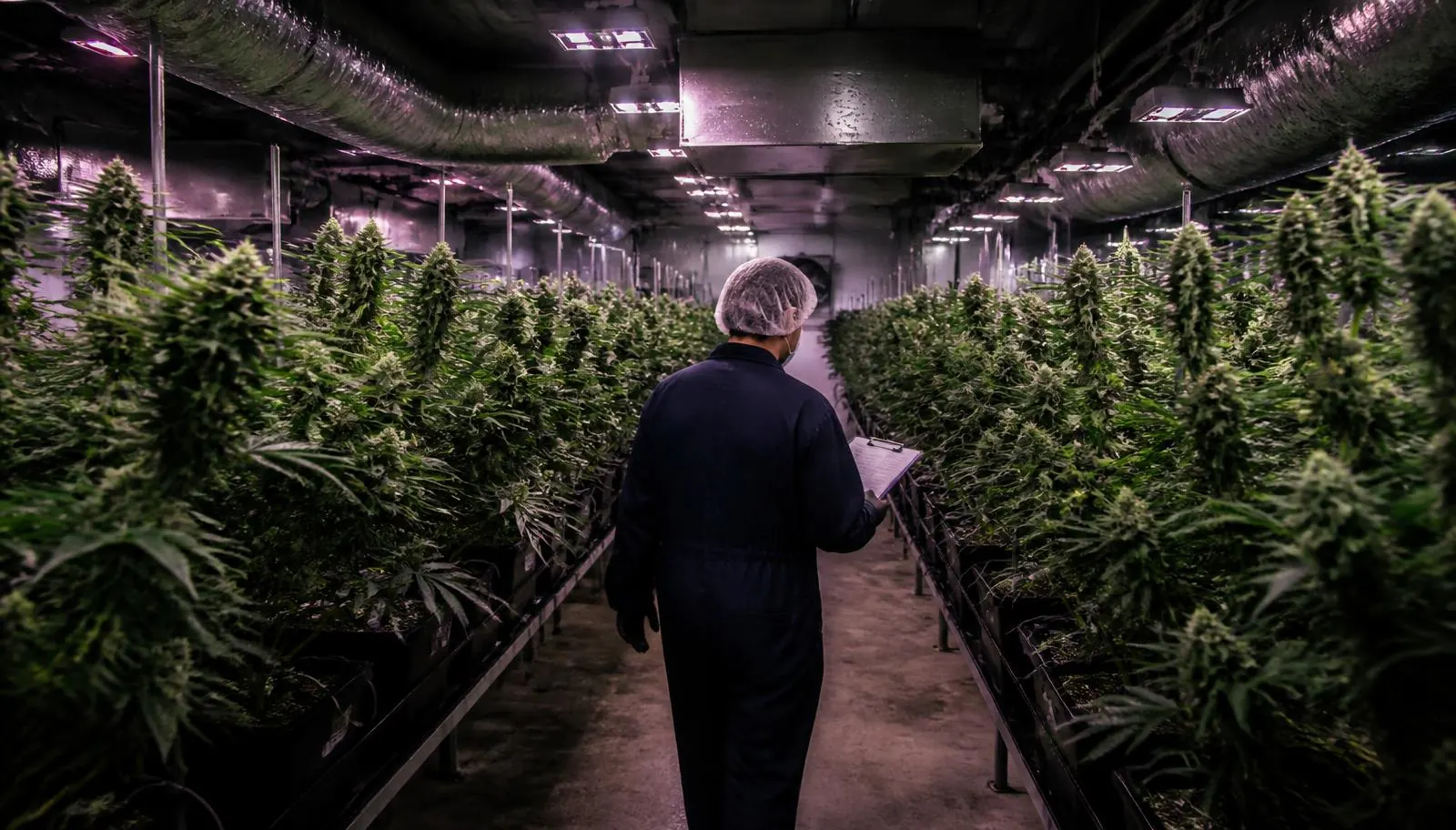
Cultivation Tax Preparation
For a producer, the return is largely a story about production costs and what remains in inventory at year end.
Preparation reviews inventory by stage, the costs the business accumulates during production, applicable labor where relevant, facility and production costs where relevant, equipment and other fixed assets, adjustments recorded during the year, and the ending inventory value carried into the next period.
Which costs are appropriately included in inventory depends on the applicable rules and the facts of the operation. There is no universal treatment that applies to every farm, and workpapers should show the method used and the records supporting it.
Cultivation accounting is covered further on Cultivators & Producers.
Processing
Processor & Manufacturer Tax Preparation
Manufacturing adds work in process, packaging and yield documentation to the year-end inventory question.
Preparation traces raw materials into production, then reviews production costs, packaging, applicable labor where relevant, work in process where applicable, finished goods, equipment and fixed assets, and the ending inventory value that drives cost of goods sold.
Yield and shrink documentation matters here more than almost anywhere else, because the relationship between inputs and outputs is what makes the ending inventory position credible. Cost treatment is fact-specific and should be applied consistently across periods.
Processing and manufacturing accounting is covered further on Processors & Manufacturers.

Payroll
Cannabis Payroll at Tax Time
Payroll has to reconcile in two directions: to the general ledger, and to the year-end payroll filings.
Preparation compares payroll registers to recorded gross wages, employer payroll costs and payroll liability balances, then compares those to the year-end payroll reporting filed for the period. Unreconciled payroll liabilities are one of the most common reasons a year-end balance sheet cannot be closed on schedule.
Where wages are coded by department, location or entity, that coding also supports the inventory and cost of goods sold analysis — but coding a wage to a production department is an accounting classification, not a conclusion about tax treatment. Payroll processing and compliance support is described on Cannabis Payroll.
- Payroll classification≠Automatic tax deductibility
- Department coding≠Automatic inventory cost
- Payroll report≠Reconciled ledger balance
Fixed assets
Fixed Assets & Depreciation
Buying equipment with cash is not the same event as recognizing an expense in the period.
Preparation reviews the fixed-asset register for completeness and accuracy: equipment, furniture and fixtures, technology, vehicles where applicable, and facility or leasehold improvements. Each asset needs historical cost, an acquisition and placed-in-service date, and accumulated depreciation that rolls forward correctly from the prior year.
Tax depreciation is then analyzed under the rules applicable to the period. Available methods and elections vary by asset type and by year, and the analysis should be documented in the workpapers rather than assumed from how a prior year was filed.
- Cash purchase≠Automatic current-period expense
- Invoice date≠Placed-in-service date
- Book depreciation≠Tax depreciation
Debt
Debt & Interest at Tax Time
Loan balances and interest should tie to lender documentation, not to how payments happened to be posted.
Preparation reconciles each loan or note to lender statements or amortization schedules, separating principal from interest, confirming accrued interest where applicable, and confirming the year-end balance. Payments posted entirely to principal, or entirely to interest expense, are a frequent source of misstated balances.
Related-party debt receives extra attention: documentation, stated terms and consistent treatment on both sides matter, particularly in multi-entity groups. The tax treatment of interest depends on the facts and on the rules applicable to the period, and is analyzed rather than assumed.
- Loan and note inventory with current terms
- Principal versus interest allocation
- Accrued interest where applicable
- Payment history reconciled to bank activity
- Lender statements and amortization schedules
- Year-end balances tied to documentation
- Related-party notes documented on both sides
Statements
Cannabis Tax Preparation & Financial Statements
Year-end financial statements are reviewed before workpapers are finalized, because the workpapers start from those balances.
The income statement is reviewed for classification and completeness; the balance sheet is reviewed account by account for inventory, cash, accounts payable, debt, tax liabilities and equity. If a balance cannot be explained, it will not become explainable once it is copied onto a return.
Financial statement preparation and management reporting are covered on Financial Reporting. Forward-looking forecasting, budgeting and cash planning sit with Fractional CFO.
- Financial statement income≠Taxable income automatically
- Financial reporting≠Tax preparation
- Management report≠Tax workpaper
Comparison
Cannabis Tax Preparation vs Tax Planning
Preparation reports what happened. Planning evaluates what may happen while there is still time to act.
| Dimension | Tax preparation | Tax planning |
|---|---|---|
| Time orientation | Historical | Forward-looking |
| Core activity | Year-end close and workpapers | Projections and scenario analysis |
| Primary output | Prepared returns and schedules | Estimates, scenarios and decisions |
| Timing | After the period ends | During the year, before year end |
| Question answered | How is this year reported? | What can be evaluated before year end? |
| Typical cadence | Annual | Quarterly or as decisions arise |
The two engagements feed each other. Preparation produces the documented history that makes planning realistic, and planning produces the estimated payments and decisions that make the next preparation cycle less eventful. Forward-looking work lives on Cannabis Tax Planning.
Comparison
Tax Preparation vs 280E Tax Planning
One is the broad year-end engagement. The other is a specialized analysis within it.
| Dimension | Tax preparation | 280E tax planning |
|---|---|---|
| Scope | Whole year-end return engagement | Section 280E and cost analysis where applicable |
| Focus | Close, workpapers, returns | Inventory costing and COGS support |
| Output | Filed returns and schedules | Documented method and supporting analysis |
| Applies to | Every filing cannabis business | Businesses subject to Section 280E |
Detailed Section 280E work — method selection, cost accounting design and documentation — belongs on 280E Tax Planning. This page uses that analysis; it does not replace it.
Comparison
Tax Preparation vs Cannabis Bookkeeping
Bookkeeping is recurring. Tax preparation is annual and depends entirely on the quality of the recurring work.
Bookkeeping records and reconciles transactions throughout the year: bank and card activity, cash, payables, payroll, inventory movement and the general ledger. Tax preparation takes the closed year and produces workpapers and returns from it.
A business can hire the best preparer available and still get a weak return if the underlying records are incomplete. Recurring work is described on Cannabis Bookkeeping.
- Monthly bookkeeping
- Year-end close
- Tax preparation
Comparison
Tax Preparation vs Financial Reporting
Financial statements and tax returns are built from the same ledger for different audiences under different rules.
| Dimension | Financial reporting | Tax preparation |
|---|---|---|
| Purpose | Financial and management decision-making | Determining and reporting tax |
| Rules applied | Accounting framework used by the business | Tax rules applicable to the period |
| Primary output | Income statement, balance sheet, cash flow | Tax workpapers and returns |
| Audience | Owners, management, lenders, investors | Tax authorities and the business |
| Frequency | Monthly, quarterly and annual | Annual, with periodic estimates |
Cleanup
Cannabis Tax Preparation Cleanup
Most businesses that call about tax preparation are really calling about cleanup. That is a normal starting point, not a disqualifier.
Cleanup starts with a diagnostic rather than a rewrite: what is actually unsupported, how far back does it go, which accounts are affected, and what evidence still exists. That determines scope honestly instead of billing for a full reconstruction that may not be necessary.
Corrections follow evidence. Where documentation exists, balances are reconciled and corrected. Where it does not, the limitation is documented so the return is prepared with a clear record of what could and could not be substantiated.
- Diagnose
- Reconcile
- Correct supported accounting
- Close year
- Build tax workpapers
- Prepare return
- Books are months or years behind
- Bank accounts have never been reconciled
- Cash activity is undocumented
- Inventory balances are unreliable
- Cost of goods sold cannot be supported
- Accounts payable balances are stale
- Payroll liabilities do not reconcile
- Debt balances do not match lender statements
- Fixed-asset records are incomplete
- Intercompany accounts do not match
- Equity activity is unclear
- Prior-year balances do not roll forward
Diagnostics
Common Cannabis Tax Preparation Problems
The same handful of issues account for most delayed, expensive or amended cannabis returns.
- Waiting until filing season to reconcile inventory
- Preparing a return from unreconciled books
- Assuming every book expense is deductible
- Cost of goods sold with no supporting workpapers
- Ending inventory estimated from a margin percentage
- Fixed assets missing from the register
- Loan balances that never tie to lender statements
- Payroll liabilities that do not reconcile to filings
- Transactions mixed between related entities
- Intercompany accounts that do not agree
- Estimated payments with no supporting records
- Carrying prior-year tax assumptions into a new period
Records
Cannabis Tax Documents & Records
A practical starting list. Actual requirements vary by entity structure, license types and engagement scope.
- Year-end trial balance
- General ledger detail for the period
- Bank, merchant and credit card statements
- Cash logs and count documentation
- Loan statements and amortization schedules
- Payroll registers and year-end payroll filings
- Inventory schedules and physical count records
- Cost of goods sold workpapers and cost records
- Fixed-asset records and invoices
- Vendor and purchase documentation
- Entity and ownership documents where relevant
- Estimated tax payment records
- Prior-year returns where relevant
- Tax notices received during the period
Checklist
Year-End Cannabis Tax Readiness Checklist
If most of these are true before filing season starts, preparation is a review exercise rather than a rescue.
- Books are current through year end
- Bank accounts are reconciled
- Cash is reconciled and documented
- Inventory is counted and reconciled
- Ending inventory value is supported
- COGS workpapers are prepared
- Accounts payable is reviewed
- Payroll is reconciled to filings
- Debt balances are reconciled
- Fixed assets are reviewed and complete
- Intercompany balances are reconciled
- Tax payments are documented
- Year-end financial statements are reviewed
- Tax assumptions are updated for current law
- Supporting records are organized and accessible
Timing
When Should Cannabis Businesses Start Tax Preparation?
The honest answer is that preparation quality is decided during the year, not during filing season.
Businesses that reconcile monthly and review results quarterly arrive at year end with a trial balance that is already close to final. Businesses that do not spend filing season rebuilding a year of activity under time pressure, which leaves less room for current-law analysis and for reviewing the return properly before it is filed.
Statutory filing and payment deadlines apply regardless of how a business chooses to manage its records, and extensions have their own rules. The applicable dates for a given entity and tax period should be confirmed each year; the Oregon Cannabis Tax Calendar gives an overview.
- Monthly accounting
- Quarterly / periodic review
- Year-end close
- Tax preparation
Prior years
Tax Notices & Prior-Year Issues
Preparation frequently surfaces questions about years that were already filed.
Common examples include notices received from a tax authority, questions about how a prior year treated inventory or cost of goods sold, differences between the prior-year return and the books, carryforward information that does not roll forward correctly, and opening balances that cannot be traced. These are addressed as part of getting the current year right.
Where a matter goes beyond preparation into examination support, that is a separate engagement described on Audit Representation. Scope, and whether a particular matter is within it, is confirmed before work begins.
Process
Our Cannabis Tax Preparation Process
A typical sequence. Depth and order vary with license types, entity count and the condition of the records.
- 01Confirm business and entity structure for the period.
- 02Review prior-year information and opening balances.
- 03Review current-year books and identify gaps.
- 04Reconcile key balance sheet accounts.
- 05Review inventory counts and valuation.
- 06Review cost of goods sold workpapers.
- 07Review payroll and payroll liabilities.
- 08Review fixed assets and depreciation records.
- 09Review debt balances and interest.
- 10Review tax liability accounts and remittances.
- 11Reconcile intercompany accounts across entities.
- 12Complete the year-end close.
- 13Prepare tax workpapers and supporting schedules.
- 14Apply current federal tax analysis for the period.
- 15Apply current Oregon tax analysis for the period.
- 16Prepare the applicable returns.
- 17Review the returns with the appropriate parties.
- 18Complete filing and authorization steps within engagement scope.
Coverage
Cannabis Tax Preparation Across Oregon
Remote-first tax preparation for licensed operators statewide.
We prepare returns for cannabis businesses throughout Oregon — Portland and the surrounding metro including Beaverton, Hillsboro, Gresham, Tigard and Lake Oswego, the Willamette Valley through Salem, Corvallis, Albany, Eugene and Springfield, Central Oregon in Bend, and Southern Oregon in Medford and Ashland. Preparation is document- and systems-driven, so the engagement runs the same way regardless of where the license is sited.
Serving OLCC-licensed cannabis businesses across Oregon — Portland, Salem, Eugene, Bend, Medford, Hillsboro, Beaverton, Gresham, Corvallis, Springfield, Albany, Tigard, Lake Oswego and Ashland. Reach us at (971) 509-9277 or advisory@cannabiscpaoregon.com.
Related
Where to Go Next
Adjacent services, industry pages and the educational companions to this page.
Questions
Cannabis Tax Preparation FAQs

Consultation
Talk with a Cannabis CPA Oregon operators actually use
Bring your OLCC license types, your current books and any open filing deadlines. We will tell you what has to be handled first, and in what order.